Blog
Super 8
Super 8 is a film about film. It's about a group of kids in the 1970s who, armed with a Super 8 camera (one of the first "home movie" technologies), set out to make a zombie film and inadvertently find themselves filming something even more "movie-like" than zombies. Of course, this then is turned into a film in itself, in the style of Spielberg.

Should Cinema be Slow and Boring?
In recent weeks, several prominent film critics have engaged in a lively back-and-forth about the question of "slow and boring" cinema. Hearkening back to the famous Pauline Kael-Andrew Sarris debates of the 60s-70s, this latest debate revives some of the classic, ongoing tensions in cinema, and raises fundamental questions about about the movies are for, and how we should watch them.
Announcing... Book No. 2
How do Christians engage the culture in a way that enriches our spiritual walk, edifies God, and contributes to broader human flourishing? How should we go about consuming potentially dicey — but also potentially edifying — areas of pop culture? How do we get the most out of that which we consume, and how do we discern what is and isn't appropriate among the vast range of cultural goods, experiences, and products to which we are daily beckoned as consumers? These are the sorts of questions I'm always asking, and they're questions that loom large in my next book project.

Babies: Born This Way?
I was recently quite disturbed by this story of a couple in Toronto who have refused to divulge the gender of their recently born child, who they named Storm (how perfectly gender ambiguous!). Though Storm does indeed have a gender, Storm's parents—Kathy Witterick and David Stocker—aren't telling anyone, not even family and close friends, what it is.
Cave of Forgotten Dreams
As in Herzog's previous films like Encounters at the End of the World (2007), which explored the culture of scientists working in Antarctica, or Grizzly Man (2005), which observed the eccentric life of Timothy Treadwell amidst the grizzly bears of Alaska, Cave is preoccupied with the interplay between natural wonders and the humans who've dedicated their lives to exploring them andunderstanding them.

How to Watch a Malick Film
The Tree of Life, like Terrence Malick's other 4 films, is rich with layers of beauty and meaning, but its also stubbornly ambiguous at times and potentially maddening. It's not a film you can fully "get" on a first or second viewing, if at all, but that's not to say that it doesn't have intense and immediate pleasures and gifts to offer, if one is willing to receive.

39 Facts About Terrence Malick
There is so little magic left in cinema, and so few figures characters who loom large enough to inspire the kind of bigger-than-life mythos formerly reserved for the likes of Orson Welles, Marilyn Monroe, Charlie Chaplin, Kubrick. Terrence Malick is one of them.
Tree of Life Debuts at Cannes
On Monday morning, Terrence Malick's The Tree of Life was seen for the first time in public, at its monumentally anticipated premiere at the Cannes Film Festival. At long last, after years of delays and steadily building hype, Life was seen by its first public audience.

The New World
Throughout World, Malick's fourth film, trees are an essential image and metaphor. Early in the film, trees anchor the boats as the European colonists arrive. At the end, tree comprise the final shot. We look upward at a towering cathedral of trees, and then the film ends with the delicate drop of a leaf.

The Thin Red Line
If The Thin Red Line is anything it is certainly a catharsis. The line between the holy and human is never as blurry within the Malick corpus as it is here. Even the form of the film, with its indistinguishable voiceovers and exchangeable characters, echoes this uncertain harmony.

Days of Heaven
With its emphasis on the duality of nature and by association man, Days of Heaven envelops us in the lack and loss of Paradise. As reflected in its title, heaven is temporal in the film—an all too evanescent state of dwelling. The film thus exudes a palpable Edenic yearning—a longing to recapture our lost wholeness of being. In the meantime, we are stuck in a world where the glory and avenging power in nature are both intensely evident—a troubling paradox in which, Malick infers, ultimate reconciliation can be achieved only in death.
Badlands
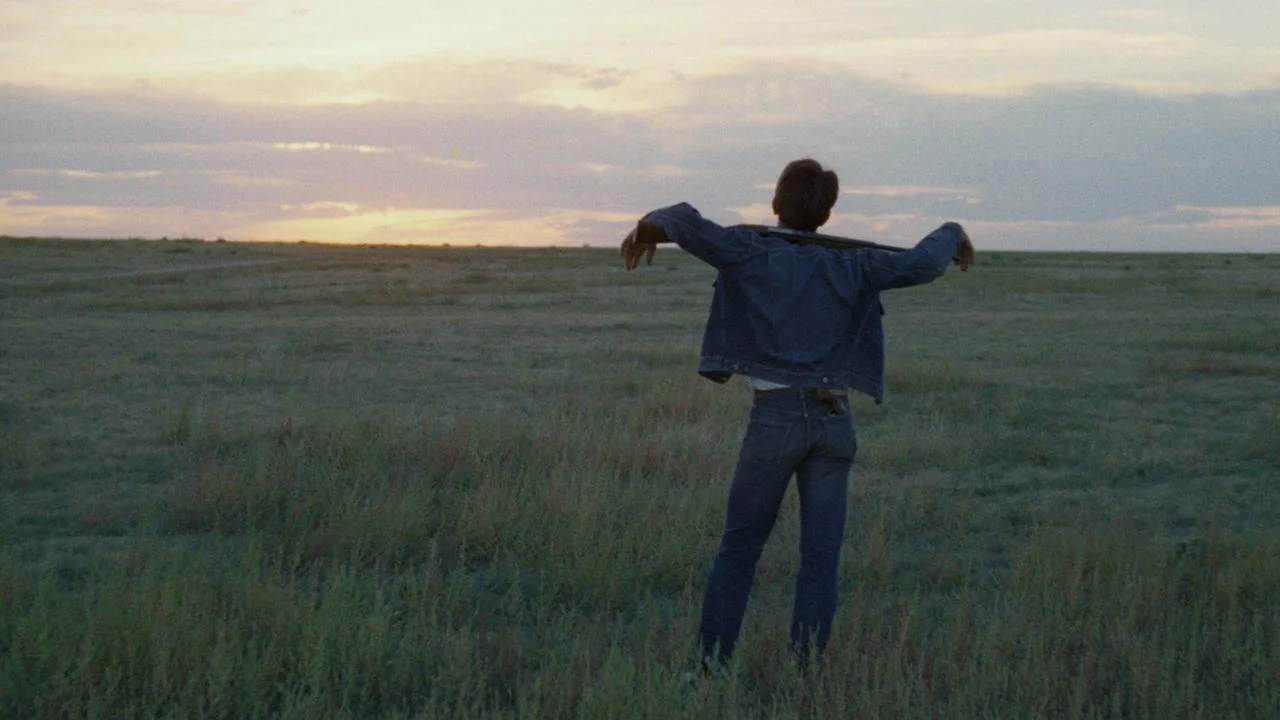
More than simply a morality tale couched in 1960s post-war nihilism, Badlands is a timeless tale of the human search for significance and the resultant battle between rebellion (pride/significance through freedom of the will) and redemption (humbly submitting to something bigger and recovering that union with creation and the Creator).
May is Terrence Malick Month
I've declared May to be Terrence Malick Month. On my blog at least.

Take Care, Take Care, Take Care
Ours is a world of ups and down. On any given day, or weekend, there is joy and heartbreak, fear and hope, sickness and death. What we can do is abide, faithfully, in hope, love & charity, working for renewal... and taking care of those around us, taking care of ourselves, taking care of the world.
Meek's Cutoff
Meek's Cutoff is the latest ponderous, gorgeously shot film from the minimalist indie director Kelly Reichardt, whose two previous films—2006's Old Joy and 2008's Wendy & Lucy—were striking examples of her delicately academic approach to cinema and interest in exploring journeying characters in moments of despair (existential, personal, psychological).
Are E-Books Good For Us?
Every April I read The Great Gatsby. The tradition started the April of my junior year at Wheaton College, when I took my copy of F. Scott Fitzgerald's masterpiece (the most perfect American novel, IMHO) to Adams Park, laid down on the newly warm grass and read through the whole book in one sunny afternoon. It was bliss.
Easter Humility
I think it's important to have restraint. If there's one thing I've been learning—and want to keep learning—it is the importance of being slow to speak, but quick to listen. I want to be a better listener, a better perceiver, a better interpreter of the world and its beauties. To take in more than I churn out... and then to churn out only after a thoughtful period of processing and active listening... that's where I want to be. As a blogger, as a friend, as a follower of Christ.
Why Bother With Church?
as a lover of the Church and a believer in the biblical call to following Christ in community, my question is: How do we make the case for attending church? Rather than throw up our hands and declare the end of the local church, what can we do to re-articulate the kingdom dream of Christ, which involves us not just as individuals but as the church body?
Oscar Dark Horses
The following are three films nominated for Oscars this year that have zero chance of winning. But I’d love to be proven wrong! They are amazing films and far better than many others they’re nominated alongside.