Christian Life, Theology, Church Brett McCracken Christian Life, Theology, Church Brett McCracken

The Lord's Supper as Time Travel

I've been thinking a lot about the Lord's Supper recently, and why I find it increasingly crucial and comforting amidst the manifold discomforts of 21st century life. It has struck me that the Lord's Supper is a bit like time-travel. The weekly eucharistic ritual, enacted by millions of Christians every Sunday, transports us simultaneously to the past, present and future. And each of these modes is beautiful and nourishing.

I've been thinking a lot about the Lord's Supper recently, and why I find it increasingly crucial and comforting amidst the manifold discomforts of 21st century life (including uncomfortable church life). It has struck me that the Lord's Supper is a bit like time-travel. The weekly eucharistic ritual, enacted by millions (billions?) of Christians every Sunday, transports us simultaneously to the past, present and future. And each of these modes is beautiful and nourishing:

Past

As we take the bread and wine of communion, we're transported back to Christ's passion. The Lord's Supper is an act of remembrance. We follow Christ's command to "Do this in remembrance of me” (Luke 22:19). Just as Passover is remembrance of God's liberating his people from bondage in Egypt, the Lord's Supper is remembrance of our liberation through the cross: Christ's body broken and blood spilt to atone for our sins. We remember our need for his nourishment. We remember the sufficiency of his grace. I find this weekly remembrance a supreme comfort and a more-necessary-than-ever gift. We are a forgetful people. Prone to wander. And today's world has little time for memory. The pace of life, the nature of technology, everything conspires against remembrance. In our frenetic, fidgety lives we must constantly be reminding ourselves of the central WHY of our faith, and the Lord's Supper is the greatest push notification we have. 

Present

To take communion is to also be present in a real time and place: present with Christ, present with one another, present in Spirit and present in truth. At a time when the trajectory of technology is away from incarnational presence and toward disembodied experience, the physical ingestion of communion elements centers us, grounds us, feeds us and unifies us in the crucial physicality of the body of Christ. And here we see that the Lord's Supper is not only an experience of connection across the boundaries of time, but also across physical space. For as we take the communion elements we are embodying the unity of all believers as the one body of Christ. Whether we are Baptists in Kansas, Copts in Egypt or Anglicans in Tokyo, the same blood of Christ is our nourishment. The same body is our bread of life. The unifying bond of the Lord's Supper goes beyond even the blood ties of family. "If blood is thicker than water," writes Wesley Hill in Spiritual Friendship, "then Eucharistic blood is thickest of all."

Future

There is a crucial anticipatory aspect of communion as well. The meal is a bit of a sacred hors d'oeuvre: it whets our appetite for the future wedding banquet, providing a tangible glimpse of the triumphant, extravagant feast that awaits us in heaven. Communion is like watching a teaser trailer for the most epic film we'll ever see, a film in which we'll also be actors. In this way it is also an act of longing, an expectant act of faith as we await the return of Christ and the reality of his fully consummated kingdom. "As often as you eat this bread and drink the cup, you proclaim the Lord's death until he comes" (1 Cor. 11:26). The future aspect is a supreme comfort in these days of immense uncertainty, when most of what we think about the future is dystopian or apocalyptic. It's easy to grow weary, almost hopeless in the midst of dire headlines and constant fear mongering. But the weekly eucharistic rhythm is an antidote of comfort and hope. 

What else in life allows us to transcend time and space in this way? What other religious ritual in human history has transcended culture, geography and time (nearly 2,000 years so far, and counting) in this way? 

The Lord's Supper is a radical, mystical, pivotal habit in the Christian life. Churches: don't neglect it. Christians: treasure it. There are a lot of things that divide Christians today, but the Lord's Supper unites us. There are a lot of things that drain us as 21st century humans, but the Lord's Supper energizes us. It focuses our distracted minds, calms our fragile nerves, nourishes our weak flesh and reminds our forgetful hearts. Thanks be to God. 

Read More
Christian Life, Theology Brett McCracken Christian Life, Theology Brett McCracken

Better Than Our Best Days

I sometimes imagine that in heaven, one of the joys of living in eternity will be that we'll have the ability to re-live the best days and best memories from our earthly lives. But I know that in heaven, all these transient things (such as 24-hour periods we once called "days") will be quaint memories compared to the "eternal weight of glory beyond all comparison" we will be experiencing.

"For this light momentary affliction is preparing for us an eternal weight of glory beyond all comparison, as we look not to the things that are seen but to the things that are unseen. For the things that are seen are transient, but the things that are unseen are eternal." (2 Corinthians 4:17-18)
 
Do you ever think about the best days of your life? Not as in a certain year or season in your childhood, but specific days. The best 24-hour periods of your life.
 
Kira and I often ask each other at the end of a year, or on an annual milestone like a birthday or anniversary, to remember the single best day of that year. It's fun to relive them. And yet it is a bittersweet thing too, because you realize that you can never relive these best days. They exist only in memories and pictures, and even those things fade with time.
 
I sometimes imagine that in heaven, one of the joys of living in eternity will be that we'll have the ability to re-live the best days and best memories from our earthly lives. I'll be able to return to that memory of lying in the grass and watching shooting starts at a Wisconsin summer camp as a child; or the time I spent in Oxford and Cambridge the summer after I graduated from college; or New Year's Eve, 2016, wandering around the churches of Rome and ending with a wine tasting dinner to ring in the new year in the Piazza Navona.
 
But I know that in heaven, all these transient things (such as 24-hour periods we once called "days") will be quaint memories compared to the "eternal weight of glory beyond all comparison" we will be experiencing. 
 
And in reality, the "heavenly" nature of the best days of our earthly lives is, if we're honest, more about a longing for permanence than the actual pleasures experienced in the moment. We want the days to linger. We want them to repeatable. And our awareness of their fleeting ephemerality is, strangely, part of what makes them so joyful.
 
Have you noticed that the most transcendent times in life often are the moments of ending, when the passing away of things is most apparent? It's the flight home after an amazing experience. It's the campfire on the last night of camp. The final song of a powerful concert. For me it's the memory of the closing worship service of Oxbridge 2005 in King's College Chapel, Cambridge. Or it's simply a sunset: the nightly, universally magnetic elegy for daylight.
 
Humans are instinctively moved by sunsets, intuitively aware that they are "beautiful." Why? I think it's because the sunset is the daily rehearsal of the reality that "the things that are seen are transient, but the things that are unseen are eternal" (2 Cor. 4:18). It's the visible affirmation that it is the temporality of this life that is the most beautiful, because it points beyond itself. It is not the oranges and reds and purples of a sunset that are the most beautiful; it's the fact that the colors are so dramatic, the sky so fiery and electric, for only a few moments. Then gone. 
 
It's a gut-level awareness we can hardly put into words, but C.S. Lewis does as good a job as anyone in his various writings about longing and joy and Sehnsucht. Take this section of The Weight of Glory:

The books or the music in which we thought the beauty was located will betray us if we trust in them; it was not in them, it only came through them, and what came through them was longing. These things—the beauty, the memory of our own past—are good images of what we really desire; but if they are mistaken for the thing itself, they turn into dumb idols, breaking the hearts of their worshippers. For they are not the thing itself; they are only the scent of a flower we have not found, the echo of a tune we have not heard, news from a country we have never yet visited.

The hope of Christianity is the hope of resurrection; it's the hope of the sunrise. It's a promise that the temporal, here-and-then-gone beauties of this life are mere teasers for the world to come.
 
The worst day in heaven will be better than our best days on earth. That's not an excuse to just endure this life and wait to "escape" to heaven. It's a hopeful invitation to dig in deeper into the beauty of this world: every experience, every song, every sunset.

Read More
Places, Seasons, Nature Brett McCracken Places, Seasons, Nature Brett McCracken

Santa Ana Winds of Change

The other night was a Santa Ana Winds night. Southern Californians know what this means. The hot, dry winds come raging down from the high desert, through the San Bernardino mountain passes. They carry dust and debris and the sage-scented shrapnel of the chaparral. They fuel fires and defrock the palms. They howl with glee as they rattle windows and send trash cans tumbling. They tip over semis and send Jacaranda purple blossoms everywhere.
The other night was a Santa Ana Winds night. Southern Californians know what this means. The hot, dry winds come raging down from the high desert, through the San Bernardino mountain passes. They carry dust and debris and the sage-scented shrapnel of the chaparral. They fuel fires and defrock the palms. They howl with glee as they rattle windows and send trash cans tumbling. They tip over semis and send Jacaranda purple blossoms everywhere. I love the way poet Dana Gioia describes them in his poem, “In Chandler Country”:

California night. The Devil’s wind, The Santa Ana, blows in from the east, Raging through the canyon like a drunkScreaming in a bar.

The air tastes likea stubbed out cigarette. But why complain? The weather’s fine as long as you don’t breathe. Just lean back on the sweat-stained furniture, lights turned out, windows shut against the storm, and count your blessings.

I love the Santa Anas. The whistling pounding of the air shaking our windows and slamming our doors shut reminds me of my Oklahoma and Kansas youth. The Santa Anas are California’s dryer version of the raging thunderstorms that rolled in off the plains and pounded our homes with humid sheets of rain and hail. There is never rain with the Santa Anas; only dust and dirt. But at least the Santa Anas typically blow only during the colder months of the year. Summers and autumns are hot enough without them.

My wife and I have lived in our current place, a 1910 craftsman bungalow we rented in Old Towne Orange, for the last three years. We’ve had our share of Santa Ana Wind nights, but even more nights that were simply unbearably hot. The 100 degree days of September and October make for restless (and sheetless) nights, especially without air conditioning. Wall AC units and fans can hardly make headway against the desert dry heat that fills the house like a furnace.

I won’t miss those sweaty nights. But I’ll miss a lot about living in this house. It’s the house we came home to after our honeymoon, the house where dozens of college students and young adults gathered on a weekly basis to enjoy good food and conversation. It’s the house where we lived our first three years of marriage, full of memories of porch talks and neighborhood walks, front yard fire pits and backyard barbecues. I’ll miss the orange tree in our yard, which gave us fresh squeezed OJ four months out of the year. I’ll miss the buzz of the Orange Circle in Old Towne, a time capsule of Americana just a five minute walk from our door.

But we are moving on. We bought a mid-century ranch house in the next town over, Santa Ana. The winds will follow us there, but hopefully they won’t feel as hot (we are installing an AC within the first few months of moving in). The citrus smells will still be there too, but more lemony-scented. Kira’s gaining an avocado tree and I’m gaining an office. All-in-all it’s a positive change. But it’s still change. In these final nights of sleeping in our first little place here on Grand Street, I’m feeling nostalgic.

These moments are bittersweet, even when they are most definitely wins. I think it’s because they symbolize time slipping away, the impermanence of all things, the moving on from a dwelling space that became a place that shaped your life. The walls and creaks and Saturday morning sounds that only memory will hereafter conjure. But this is life. It’s always moving on! The winds of change are a constant, as brutal and beautiful and certain as the Santa Anas.

Read More
Movies, My reviews Brett McCracken Movies, My reviews Brett McCracken

Everybody Wants Some (More Time)

It may be true that “You cannot conquer Time,” but the attempt to conquer it through moment-capturing art and particularly cinema can be quite beautiful. This pretty much sums up Richard Linklater’s "Before" trilogy, his "Boyhood" masterpiece and his just-released "Everybody Wants Some." Linklater is a filmmaker who knows well the powerful potential that cinema has to capture that peculiar, elusive mystery of time.
"The years shall run like rabbits, For in my arms I hold The Flower of the Ages, And the first love of the world."

But all the clocks in the city Began to whirr and chime: "O let not Time deceive you, You cannot conquer Time.

-W.H. Auden (“As I Walked Out One Evening”)

Ethan Hawke’s character quotes these Auden lines to Julie Delpy in Before Sunrise (1995), Richard Linklater’s first film in a trilogy whose sequels (2004’s Before Sunset and 2013’s Before Midnight) complete a trilogy about love, impermanence and the passage of time.

It may be true that “You cannot conquer Time,” but the attempt to conquer it through moment-capturing art and particularly cinema (which Andrei Tarkovsky calls “sculpting in time”) can be quite beautiful. This pretty much sums up Linklater’s Before trilogy, his Boyhood masterpiece and many of his other films, including the just-released Everybody Wants Some. Linklater is a filmmaker who knows well the powerful potential that cinema has to capture that peculiar, elusive mystery of time: at once something painful and beautiful, relentless and restorative.

Everybody Wants Some is ostensibly a raunchy R-rated college comedy, a “spiritual sequel” of sorts to Linklater’s 1970s comedy Dazed & Confused (1993) and something in the vein of a Seth Rogen sex comedy. But really this is a film as much about the preciousness and the pain of time’s passage as any of Linklater’s more “refined” arthouse films. Everybody Wants Some is less overt in its philosophical probings than, say, Waking Life (2001) or Slacker (1991), but it is no less profound.

The film plays out in the final weekend of summer before the start of the semester at a Texas college. Periodic “__ hours left until classes begin” text on screen reminds us of time’s passage throughout, much like the real-time framing of Before Sunset or Before Midnight do, or the “watch actors grow before your eyes” structure of Boyhood. Time’s persistence is inescapable in Everybody Wants Some, but not in depressing way. Not in a nihilistic YOLO way either. This is just life, universal: the end of summer, the transitions of the seasons, the beginnings and ending of friendships, the losses and gains of growing up.

Everybody Wants Some follows a hard-partying baseball team living in a raucous college house. New freshmen have arrived and go through predictably funny hazings. Parties and beer and bongs and sex pervade. But nothing all that exciting happens. What is surprising about the film is how much of it is actually about the mundane ways the men in the house “pass the time” as it slips away: ping pong games, darts, knuckles, basketball, drinking games, marijuana games, and other pre-digital amusements. Games. Competition. Striving. The film ponders the centrality of such things in human existence, competition as a primary mechanism by which we make sense of time and our place and purpose within it. Sex is situated in this context, as one among many ways that the cycle of victory, defeat and struggle plays out.

The Greek myth of Sisyphus is invoked in a beautiful conversation between two characters late in the film, and it’s a thematic lynchpin. Whatever else may be recalled as we look back on our lives, the passion and striving to do something, to make a mark, to win, is everywhere evident. Whether it be baseball or parenting (see Boyhood) or trying to stay awake in class, challenges mark our lives. When they don’t, we must invent them, which is why sports, games and competitive amusements (fantasy football anyone?) rise in popularity in cultures where survival needs are met and comfort reigns (“Frontiers are where you find them,” writes a professor on the chalkboard at the end of the film).

Everybody Wants Some is brilliant not only in its observations about the striving nature of man in a universal sense, but also in its perceptive portrait of these specific men in this particular place at this particular time. Like Linklater’s Boyhood or Malick’s Tree of Life (to name just a few examples), the experiences of these individuals in a particular culture and time are highly specific and yet deeply resonant. They are slices of time, cross-sections of particularity that capture Texas jock life circa 1980 so well that even those far from that world can see themselves in it.

This sort of art invites a familiarity not in that we all nostalgically recall frat house beer bongs and line-dancing to "Cotton-Eyed Joe,” but that we all can locate ourselves in the passage of time, wherever we were then or are now. We recall moments and seasons. Period films, those that truly care about every detail and ambient texture of the time (like this one), compel us in part because they confront us with the reality of time, what was and is no more. This is what makes a film like Boyhood, with its bittersweet chronicling of the all-too-quick passage of childhood, so poignant.

At a time in history where the recording of the present (via photography, for example) is easier than ever but so quickly cycled through or amassed to the point of meaninglessness, deep dives into the intricacies of forgotten moments are so valuable. Art that shows us the beauty of everydayness past helps us to better appreciate everydayness present, a harder-than-ever appreciation in our world of infinite distraction and disposal.

Though technology lures us with various “conquer time!” temptations, we ought to resist them and go the way of Auden and Linklater and the many others who beckon us to slow down and embrace our sand-through-an-hourglass lot. Life is a perpetual sunset, a fact that inspires us to strive and fight and lament and love. Everything passes. What will remain?

Read More
Movies Brett McCracken Movies Brett McCracken

Boyhood

I think it was Kierkegaard who said that while life is lived forwards, it can only be understood backwards. Certainly most art proves the truth of this statement. While life presses on breathlessly and leaves nary a moment for sense-making, artists are the ones who press pause and rewind, arranging the pieces, plot-points and colors for us in such a way that the full (or fuller) picture is seen.

Nothing I cared, in the lamb white days, that time would take me Up to the swallow thronged loft by the shadow of my hand, In the moon that is always rising, Nor that riding to sleep I should hear him fly with the high fields And wake to the farm forever fled from the childless land. Oh as I was young and easy in the mercy of his means, Time held me green and dying Though I sang in my chains like the sea.

-From "Fern Hill" (Dylan Thomas)

“In a certain sense the past is far more real, or at any rate more stable, more resilient than the present. The present slips and vanishes like sand between the fingers… Time cannot vanish without a trace for it is a subjective, spiritual category; and the time we have lived settles in our soul as an experience placed within time.”

-Andrei Tarkovsky, Sculpting in Time

I think it was Kierkegaard who said that while life is lived forwards, it can only be understood backwards. Certainly most art proves the truth of this statement. While life presses on breathlessly and leaves nary a moment for sense-making, artists are the ones who press pause and rewind, arranging the pieces, plot-points and colors for us in such a way that the full (or fuller) picture is seen. Most artists spend a good amount of their career (if not the whole of it) exploring their own histories, searching their lived past and re-creating it or reckoning with it in a manner that proves at the very least personally therapeutic and at best profound and transcendent for wider audiences.

Terrence Malick's films are good examples of this. His recent films (To the Wonder and The Tree of Life) have been intensely, almost indulgently personal; yet they capture essences of things, "universes in grains of sands" so to speak, in beautiful ways. The latter film is Malick's exploration of his own Texas boyhood, standing in for all boyhoods and, at times, for all of life period.

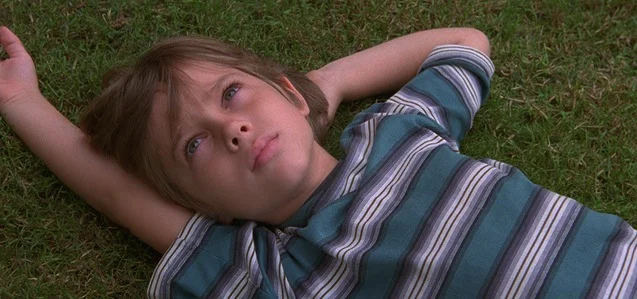
Richard Linklater's Boyhood does a similar thing, narrating a semi-autobiographical coming-of-age story while at the same time evoking the universal. In both cases (Malick's Life and Linklater's Boyhood) the most resonant and transcendent moments arise from the most mundane and yet sharply perceived bits of minutia. These films are not metaphysically robust because they wax philosophical (though both do, at times) but because they pay attention to the little moments: hosing grass off the bottom of one's foot on a summer day, reading Harry Potter books to children before bed, etc. Both films succeed because they focus less on a traditional plot structure than an episodic tableaux: capturing the overall picture and mood, impressionistically, through select scenes, glimpses, reminiscences of childhood. Given the huge amount of history to work with, and in both cases a huge amount of film from which to edit, both Malick and Linklater distill emotions and truth expertly from the mound of  "time" they have to work with. In this way they epitomize what Tarkovsky says is the essence of the film director’s work: "sculpting in time.”

Linklater, perhaps even more than Malick, has been particularly fascinated with cinema as "sculptor of time." How can the moving image help us understand and appreciate the complexity of time? In films like his Before trilogy and now Boyhood, Linklater takes up the question in remarkable ways. These films don't merely re-create times past (as most films do, including Malick's) but rather document time as it passes. For Linklater, time itself is quite literally the biggest star in his movies. Sometimes this requires immense patience. His Before series has required the investment of Linklater and the series' two actors (Ethan Hawke and Julie Delpy) over the course of twenty years. Similarly, Boyhood required yearly commitments from its actors since 2002. But the results are profound. Part of what makes Boyhood and the Before series so significant (and I believe they will only rise in significance in decades to come) is that they evoke the passage of time--indeed, aging and growing up--without the magic of makeup or CGI but simply through turning on a camera after periods of time have gone by. Michael Apted's astonishing Up series also does this.

Another way Linklater focuses in on the curiosity of time is by shooting in real-time. Several sequences in the Before series unfold in uninterrupted single takes and all of them occupy merely a few hours in their characters' lives. Linklater's 2001 film Tape unfolds entirely in real-time. His 1991 classic Slacker takes place entirely in one day in Austin. Linklater recognizes the powerful documentary aspect of film in that it can capture slices of life (or slices of time) like very little else can. Like a photographed image, a film transports us to another place and time. But a moving image can arguably immerse us in those long lost "sand between the fingers" moments more fully, capturing the unfolding in time aspect of life in a way static images cannot.

A third way Linklater's films reflect on time is by having his characters wonder aloud about it. In the Before series, Jesse (Hawke) and Celine (Delpy) are always talking philosophically about time, musing about lost time on the Left Banke of Paris, quoting W.H. Auden in Vienna ("O let not Time deceive you") or pondering impermanence as they watch the sun set in Greece. Characters in Slacker and Waking Life (2001) are similarly fascinating by time. The latter film's discussion of André Bazin, cinema and "holy moments" seems particularly salient for Linklater himself, as the transcendent potential in capturing spontaneous existence seems to motivate much of his filmmaking.

Certainly Boyhood has its fair share of what may be called "holy moments." It has a lot of tragic moments as well, to be sure, as does Malick's Tree of Life. But both films favor the charged goodness of life's "holy moments" as fortuitously recorded by the camera. Where the holiness Malick sees in cinematic moments speaks to something Other and transcendent, however, Linklater's "holiness" inheres in the moments themselves. For him, the very act of capturing moments through a camera, thereby arresting the otherwise painfully indifferent onward march of time, is where transcendence is found. It's worth noting that Mason (Ellar Coltrane), the "boy" of Boyhood, finds himself drawn to photography as the one consistent source of meaning in his life. In a life where no house, no father figure, no friend stays around for very long, Mason clings to the "pause" power of a photograph to stop time and preserve a fleeting moment for a bit longer.

This is exactly the power of cinema on display in Boyhood, and it's why the film is such an magnificent achievement. As specific as it is to this one boy and his coming of age story (from age 7 to 18), and as relatively intimate and mundane as its storytelling may be, the film nevertheless feels epic and existentially resonant.

As I reflected on the film I thought of my experience a few weeks ago in Scotland, exploring the streets and hills in Motherwell, where my grandfather spent his boyhood--when he was "young and easy in the mercy of his means," as Dylan Thomas would say. I thought of how inaccessible the reality of his childhood is to us now, apart from a few photographs and passed-down, half-forgotten memories. But then my own boyhood is the same way. More photographs and video documentation of it may exist, and my memories of it are still clear. But they are fading and will one day disappear, as will the physical artifacts and photos. Eventually my descendants will render my life only sketchily in their imaginations, and then not at all.

The power of poetry like that of Dylan Thomas's "Fern Hill," or films like Linklater's Boyhood, is that they do what any human with memories longs to do: they reconstruct the elusive past, vividly conjuring holy moments of old that would otherwise be lost. This is the power of narrative generally.

I've often wondered if in heaven we will have infinite access to re-constituted past: a sort of "on-demand, all you can watch" pass to travel back and watch any moment in history unfold, whether our own childhood or that of Christ. Perhaps eternity will bring all time and history into wholly manageable perspective. Perhaps Marilynne Robinson is right when she speculates, in Gilead, that “In eternity this world will be like Troy, and all that has passed here will be the epic of the universe, the ballad they sing in the streets.”

Maybe so. But in the meantime, I'm thankful that God created us to be creative, so that Homers and Linklaters and Malicks can help us bridge the gaps in our experience and grab hold of time even as it slips away.

Read More
Movies, Theology and Art Brett McCracken Movies, Theology and Art Brett McCracken

Catching Up With Time in the “Before” and “Up” Films

A professor I admire once said — while discussing the films of Yasujiro Ozu, or maybe it was semiotics (can’t remember) — that watching the sun set can be both a thing of incredible beauty and deep sadness, often simultaneously. I thought of this as I watched Richard Linklater’s Before Midnight, which includes a scene of a couple sitting by the sea in Greece, watching the sun slowly dip below the horizon. It’s there, there, there — and then it’s not there. A fleeting flare of arresting orange. Present and then absent. Perhaps the beauty and sadness of a sunset has to do with the fact that it’s the process in nature we humans most identify with. Ours is a context of ephemerality.

A professor I admire once said — while discussing the films of Yasujiro Ozu, or maybe it was semiotics (can’t remember) — that watching the sun set can be both a thing of incredible beauty and deep sadness, often simultaneously. I thought of this as I watched Richard Linklater’s Before Midnight, which includes a scene of a couple sitting by the sea in Greece, watching the sun slowly dip below the horizon. It’s there, there, there — and then it’s not there. A fleeting flare of arresting orange. Present and then absent. Perhaps the beauty and sadness of a sunset has to do with the fact that it’s the process in nature we humans most identify with. Ours is a context of ephemerality.

Midnight just released in theaters, and it is certainly one of the best films of 2013 so far. But before you see it, be sure to watch the two preceding films in Linklater’s Before series: Before Sunrise (1995) and Before Sunset (2004). Together they comprise a trilogy that is one of the most understated and elegant in the history of cinema.

Linklater’s films follow the love story between Jesse (Ethan Hawke) and Celine (Julie Delpy) as it plays out in more or less real time in one Vienna night in 1994 (Before Sunrise), a sunset stroll in 2003 Paris (Before Sunset), and an evening jaunt in Greece in 2012 (Midnight). The films let us peek in on these two lives every nine years, witnessing only as much of their “present” as the 90-100 minutes of movie watching allows us to see. The glimpses we get into this couple’s journey together are snapshots not just of their particular world — compellingly characterized by highbrow garrulity, philosophizing and Gen X angst — but of humanity in general: how we age, how we love, how we fight and how we dream.

Similar in many ways to what Linklater, Hawke and Delpy are exploring in the Before series is what Michael Apted has done and is doing with the astonishing Up series. Beginning in 1964 as a British television documentary examining the lives of fourteen 7-year-old children representing a diverse array of socioeconomic positions in 1960s Britain, the Up series has followed its real-life characters every seven years since. 14 Up (1970) checked in on the children at age 14; 21 Up (1977) updated audiences on their lives as they each turned 21; and so on.56 Up just came out a few months ago and is now available to watch on Netflix, as are all of the other Up films.

In his review of 56 Up, the late Roger Ebert — who once called the Up series “the noblest project in cinema history” — wrote this: “It is a mystery, this business of life. I can’t think of any other cinematic undertaking that allows us to realize that more deeply.”

Indeed, I think that one of the great potentials of cinema — particularly when it is used in the way Linklater and Apted are using it in their respective series — is that it can capture some of the idiosyncrasies and mysteries of the “business of life” that we might otherwise fail to see (presumably because we are too busy wading through our own “business of life”). Things like the peculiar experience of the passage of time: simultaneously the most obvious and yet ungraspable mystery of existence.

The Before series is about love and relationships on one level, to be sure. But the real subject of these films is time, and the frequency with which it is discussed by the characters in the films hammers home that point.

“O let not Time deceive you, You cannot conquer Time,” says Jesse (Hawke) in Before Sunrise, quoting Dylan Thomas quoting W.H. Auden. At other times Jesse waxes philosophical about how surreal it is to self-consciously observe himself living in real time, or Celine shares about how she always feels like her life is either a dream of the future or a memory of the past. Meanwhile, the couple walks and talks in (more or less) real time, as the sun — that most vivid of all reminders of temporality — either rises, sets, or cedes its position to the moon. As Hawke said earlier this year when Midnight premiered at Sundance, the star of the Before series “is not Julie or [Hawke] but Father Time himself.”

The Up series is far less meta in its treatment of time; yet like the Beforefilms, Father Time is a palpable presence in every frame. There’s something compelling about observing the passage of time — 56 years, in this case — as it molds, batters, refines and weathers these people on each of their wildly divergent paths. Some of the original fourteen children grew up to be very successful; others not so much. Most started families and now have kids, grandkids, stepkids, and exes. Some (but not all) exceeded the expectations of the social class into which they were born. Some are happier than others (from what we can tell in our peeks inside, at least), and the only thing they all have in common is that none, not a one, has conquered time. They are all aging, and with every passing Up film we feel the weight of this ever more.

Cinema is unique among mediums in its ability to “sculpt in time,” as Andrey Tarkovsky wrote. It’s all about compressing, elongating, speeding up, and editing time to tell a story (that may span millennia or minutes) in the span of just a few hours. But Before and Up are especially compelling because rather than focusing on the filmmaker’s power over time, they focus on time’s power over us. Linklater tries his best to tell each Before film in real time, avoiding cinema’s manipulative power and instead foregrounding the somewhat eerie feeling of just sitting with time as it unfolds.

The Up films leverage cinema’s ability to compress time by including footage from the previous entries in each present portrait. What we get is essentially a moving-image scrapbook of each of these peoples’ 56-years, summarized in about ten minutes each. Watching it evokes the emotions of looking through an old box of photos and reliving an entire past in one quick burst of nostalgia. It confronts us with the expansiveness of what has come before; which seems large to us because our memories are painfully small and cannot hold every special moment we’ve had or beautiful thing we’ve seen, let alone the histories of other lives and lands.

Unless we have cameras there to capture every moment, our pasts are just as inaccessible to us as our futures. Memories, photos, tales of old can only reconstruct former glories up to a point (for a smart take on all this as it relates to “documenting” one’s past, see Sarah Polley’s amazing new film, Stories We Tell). And yet it could be argued that the “present” is the most elusive of all. For in reality, what we think of as the present is really just our brain processing things in the past — even if just a millisecond ago. Time is most relentless in the present because try as we might to slow it down or speed it up, it only goes by its own pace. The past and future are more malleable categories because they exist entirely in our minds, where we can elongate, embellish, or edit our recollection or vision of an experience, to our liking.

Tarkovsky puts it well in this excerpt from Sculpting In Time:

“Time is said to be irreversible. And this is true enough in the sense that ‘you can’t bring back the past’. But what exactly is this ‘past’? Is it what has passed? And what does ‘passed’ mean for a person when for each of us the past is the bearer of all that is constant in the reality of the present, of each current moment? In a certain sense the past is far more real, or at any rate more stable, more resilient than the present. The present slips and vanishes like sand between the fingers, acquiring material weight only in its recollection.”

The Before and Up films are powerful because they embody the “sand between the fingers” brevity of the present: reminding us that even the most magical moments in life are fleeting, that our “when I grow up” dreams will be here and gone before we know it, and that as a result it makes little sense to live in search of a permanent state of pleasure or satisfaction. Such a thing would be, as Solomon might say, like “chasing after the wind.” Our hearts will be restless, said Augustine, until they rest in Thee. And perhaps that is “Father” Time’s greatest gift to us: stirring up a restlessness in our souls that directs our longing to something Other, unfathomably infinite and unbound by time.

Read More
Places, Seasons Brett McCracken Places, Seasons Brett McCracken

Take Comfort in Rituals

Why are rituals such a blessing? Why are they so comforting? Why—after spending 10 days seeing amazing things on another continent—was I so excited to return to the routine rhythms and rituals of my "normal" life back home? Why am I confident that some day, I will go to bed at the same time every night, have the same breakfast cereal every day while watching the same morning show, and love every minute of it?

I love Starbucks. Unabashedly. Starbucks is like Coldplay or The Shawshank Redemption: wonderful things that are widely beloved and thus not "cool" to like... but wonderful nonetheless.

I also love Starbucks' new advertising slogan—Take Comfort in Rituals—for a number of reasons. I love it because it's just so right for Starbucks' brand. As someone who works in marketing/advertising for a living, I have huge respect for brands that get their messaging so right. But I also love it because, for me, it captures precisely why Starbucks is so appealing.

Every Sunday morning, before church, I go to my local Starbucks to read for a few hours, have a tall dark roast drip coffee, and eat a breakfast sandwich. It's the one time of the crazy week that I set aside—no matter how busy I am—to stop what I'm doing and relax with coffee and a good book, preferably something I'm not required to read. Starbucks has comfy chairs, reliably good coffee, and I always know that wherever I am in the world, Starbucks will be also (confession: I went to at least 3 Starbucks in Shanghai a few weeks ago). I look forward to my weekly ritual at Starbucks; I take comfort in it.

Why are rituals such a blessing? Why are they so comforting? Why—after spending 10 days seeing amazing things on another continent—was I so excited to return to the routine rhythms and rituals of my "normal" life back home? Why am I confident that some day, I will go to bed at the same time every night, have the same breakfast cereal every day while watching the same morning show, and love every minute of it?

Perhaps one reason is because rituals make the chaos of life just a bit more manageable. And the older we get, I think the more we can appreciate anything that will help decrease the chaos.

Perhaps it's also because there's something transcendent about repetition, about the mundane and predictable patterns of life. The seasons, for example. They happen every year, like clockwork... and there's something gloriously moving about that.

Paradoxically, it seems that things like repetition, ritual, and regularity actually make our battle against time easier. The tyranny of time—which is that it constantly reminds us of impermanence, deterioration, and mortality—is somehow diminished in rituals, which help bring a semblance of continuity and constancy to an otherwise constantly changing existence.

Or maybe rituals are appealing because when we find something that works for us, or gives us joy, we often go back to to it time and time again. Things like sitting in a coffeeshop with a good book, or being with family on Christmas, or listening to Parachutes on a melancholy evening. Things that give us a reprieve from surprises and spontaneity (which can also be good!), and connect us with former but familiar versions of our self.

The process of it all is a gift. And I certainly take comfort in it.

Read More
Movies Brett McCracken Movies Brett McCracken

Toy Story 3

From the outset of Toy Story 3—where we discover that Andy is going off to college and must either give away, throw away, or relegate his toys to the attic—there is a profound and universal sense of loss. Things change. Nothing is permanent. Everyone grows up and must leave their childhood behind, once and for all.

Despite the fact that it's another joyous, action-packed, endlessly entertaining and laugh-out-loud Pixar spectacle, there's something immediately melancholy about Toy Story 3. Perhaps it's the fact that this is the third and likely last in a trilogy that we've all grown so fond of. Perhaps its because Pixar just knows how to do sadness (see Up, Wall E, etc). But mostly I think it's because Toy Story reminds all of us of our own childhoods—of those whimsical, carefree worlds of make believe that occupied the free time we now fill with work and stress. Oh for the days of youth! The Toy Story trilogy captures it so well, and the third installment beautifully, affectingly evokes one of its most bittersweet aspects: Growing up.

From the outset of Toy Story 3—where we discover that Andy is going off to college and must either give away, throw away, or relegate his toys to the attic—there is a profound and universal sense of loss. Things change. Nothing is permanent. Everyone grows up and must leave their childhood behind, once and for all. I teared up during the opening sequence of the film, anticipating how it would end. And sure enough, I was a weeping mess by the end. I don't think I've cried more in a movie since maybe A.I.

Which is interesting, because A.I. is also a film about toys with feelings. What it is about this that is so heartbreaking? Maybe it's because in our consumer culture our toys and collected possessions really do take on personal, relational—even spiritual—significance for us. Maybe it has something to do with the recognition that, while the world changes and we grow up, change, and eventually die, the objects and artifacts that lend meaning to our lives at various stages do not change or age or die. They are just discarded. So, when we anthropomorphize something like a cowboy doll or robot, and imagine that there truly is a two-way reciprocal love going on between it and the human, of course we are going to feel devastated when someone like Andy doesn't find it too difficult to move on and leave Woody behind. Woody is just a toy. But from Woody's anthropomorphic point of view, it's like the worst sort of rejection: The one person who you've always loved and who it has been your life's purpose to love unconditionally does not entirely reciprocate those feelings. It's the same tragic scenario Hayley Joel Osment's robot character faces in A.I. And in both movies, it's utterly devastating.

Another film I thought of as I watched Toy Story 3 was Summer Hours—the critically acclaimed French film from 2009 starring Juliette Binoche. Like Toy Story 3, Summer Hoursis about what impermanence means both for humans and for the objects humans acquire. It's about people dying and their possessions being disbursed to the next generation, where new meaning and significance will undoubtedly be ascribed to them. In both films, the reality of "what happens to my stuff"—when I leave, or move, or die—is of central concern.

But it's not really about the stuff. Toy Story is not really about toys. It's about the reality of the passing of time—a painful, relentless, unnatural phenomenon that—for creatures like us who were made to be eternal, always feels a bit like an ill-fitting coat.

Read More
Movies, Places Brett McCracken Movies, Places Brett McCracken

Summer Hours

The film—as its title implies—is about time. The passage of it. The joy and tragedy of living temporally.

Having just come back from France, and needing desperately to get the bad taste of Antichrist out of my mouth, I went to see Summer Hours over the weekend—a French film directed by Oliver Assayas and starring Juliette Binoche and Jeremie Renier. It was just what the doctor ordered, and more. Summer Hours was two summer hours of pure cinematic bliss, a film I have no hesitation calling a masterpiece and perhaps the best film of the year so far.

The film—as its title implies—is about time. The passage of it. The joy and tragedy of living temporally.

The plot of the film is gloriously simple. It’s about a French family dealing with the death of its matriarch. The film opens with a joyful summer scene at one of those storybook country houses in rural France. The whole family has gathered here for a reunion and celebration of grandmother Helene’s (Edith Scob) 75th birthday. As the children and grandchildren gradually disperse and go their separate ways at the conclusion of the festivities, Helene is left alone with the sadness of a once-again empty house and a feeling that her days are numbered. And indeed, within the year she is dead.

After Helene’s passing, her three children return to the house in France to consider the fate of the estate. Will they keep or sell the house? And what of the esteemed art collection and museum-quality pieces that are in the house? Will they stay in the family or be sold off to collectors and museums? Quickly, sadly, and all-too-realistically, the siblings decide that they need cash more than antiques. They sell the house and go about the business of selling off their families prized possessions.

The majority of the film is an observance—a quiet, curious, melancholy observance—of the minutiae and business of getting the estate sold off. It’s about the process of tidying up affairs after a death. It’s about moving on and clearing the way for the next phase of life. It’s about our entrances and exits and the ambivalent banality of it all.

I think one of the reasons this film affected me so much is that my own grandmother’s house—the house my mother and uncles were raised in and the house I grew up visiting—was recently sold and all of its furniture and belongings dolled out among the children and grandchildren. My grandmother was put in a nursing home and her whole material life was left behind and now liquidated. It’s a terribly sad thing, to realize that something so spirited and alive as a house could so quickly turn into a lifeless relic or alien structure with new tenants. It’s so weird to see a material history evaporate with a few handshakes, pen strokes, and an interchange of documents. But so is life: it’s all so very evanescent.

Summer Hours is about the beauty and meaning of objects. It raises interesting, profound questions about why we treasure certain things and what gives a vase or desk or painting “value.” Is it the story behind it, or the way we use it? Is it the beauty and craftsmanship of the thing itself? Is a vase designed by a famous master more “alive” in a museum or in a rural cottage with a bouquet of flowers sticking out of it?

But the film is also about life, and how it is so much more than objects and mementos and the bric-a-brac of our everyday accumulations. It’s about the hours we spend with our families, running around on a summer evening in a forest or field, sipping wine or eating quiche. It’s about the love and passion and sadness we share.

The house at the center of Summer Hours is an impressive structure and perhaps the most important character in the film. It’s the one constant—and there is a decidedly ghostly quality to the way that it transitions from a bustling center of family and furniture to an empty re-booted tabula rasa, ready for the next family to move in. If these walls could talk, what would they say? Summer Hours mulls this question but easily concludes that, in the end, walls and objects cannot talk. Their meaning is derived only and ever through the experiences of people who use them and see them in different ways and for different reasons.

There is a major gulf between humans and objects, and it has to do with time. The former decays far more rapidly than the latter. People almost always die sooner than their accumulated, material lives. Our footprints and letters and blankets and beds will long outlive us, though they will frequently move on and forget they ever accompanied us for a time. And this is the film’s most beautiful and heartbreaking realization—that humans are mostly just passing through, ruffling up the earth and fabrics and rocks and trees for a time, but then passing the torch to the next generation. It’s not a good or bad thing. Like the unchangeable persistence of time, it’s just the way that it is.

Read More

Subscribe To Blog